Language:
 
 
Pages:
  
1.Introduction
2.Getting Started
3.Video Format Settings
 
3GP
AVI and DV-AVI
Flash Video
MPEG 1
MPEG 2
Apple iPod
Sony PSP
QuickTime
WMV Custom
WMV for Desktop Viewing
WMV for Internet Streaming
WMV for Progressive Download
4.Audio Format Settings
5.Tools
6.Application Settings
7.Troubleshooting
8.Resources
 

Digital Media Converter 4.01


Configure WMV Files for Desktop Viewing

To configure WMV for Desktop Conversion Settings:
Formats >> Select Standard Format >> WMV for Desktop Viewing >> Configure

WMV for Desktop Viewing

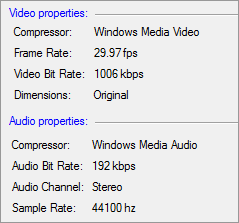
The video profile selected is High Quality Video (CBR), the audio profile is High definition quality audio (CBR) and the Video Dimension is the same as the original file.

By default, the Encoded Bitrate is set at 1134 Kbps and the frame rate at 29.97 Fps.  The output file size will be the same as the original file after conversion.

Select MBR Stream, Bitrates and Preserve ID3 Tags

Selecting an MBR Stream

If you plan to deliver your content as a stream from a server running Microsoft Windows Media Services, encoding multiple bitrate streams provides better quality during times of network congestion (or over a slow network connection).  When you set up an MBR stream your content is encoded at every bit rate you specify.  When a player receives an MBR stream, only the stream that is the most appropriate for current network conditions plays.  The Windows Media server and player handle the process of selecting the appropriate stream, which is invisible to the user.  You can only use CBR encoding when creating an MBR stream.

You can encode MBR streams for both audio and video content; however, it is not necessary to use MBR encoding for both audio and video in a single stream.  For example, you can stream audio at one bit rate and have multiple bit rates for the video portion of the stream.  Also keep in mind that encoding an MBR stream uses more processing power.  Select a range of bit rates that you think will meet the playback needs of the audiences you are targeting.

Selecting Bitrates

For files that will be streamed over a network, you must consider carefully what bit rates you should use.  Under most circumstances you can add the bit rates of all of the streams in a file together to get a general idea of the available bandwidth required to stream the file.  However, a certain amount of overhead is also required for each stream.  This overhead is summarized in the following table:

Bit Rate Range (Kbps) Additional Bandwidth Required for overhead (Kbps)
10 - 16 3
17 - 30 4
31 - 45 5
46 - 70 6
71 - 225 7
> 225 9

You must also consider that the theoretical maximum bandwidth available over a network connection is not a practical target bit rate.  The average available bandwidth for any given connection falls well short of the bandwidth capacity of the connection, because of network traffic and many other factors.

Preserve ID3 Tags (file description details)

By default, Digital Media Converter retains metadata (like song titles and names of the artists) from your source file.  To avoid it, uncheck this option.


Copyright © DeskShare Incorporated.  All rights reserved.