DeskShare homepage Deutsch   Français    Español   Portuguese   
.
  Support  
 
 
Pages:
  
1.Index
2.Getting Started
3.Working With Media Files
4.Converting Media Files
 
Starting and Stopping Conversions
Select Files to Convert
Changing Conversion Settings
Configuring AVI Properties
Configuring QuickTime Properties
Configuring MPEG 1 and VCD Properties
Configuring MPEG 2, SVCD, and DVD Properties
Configuring MP4 Properties
Configuring Flash Video Properties
Configuring 3GPP and 3G2 Properties
Configuring WMF Properties
 
Configuring files for Desktop Viewing
Configuring files for Streaming
Configuring files for Web Server Progressive Download
Configuring Files For Portable Devices
Selecting an MBR Stream
Selecting Bit Rates
Configuring WAV Properties
Configuring MP3 Properties
Configuring AAC Properties
Configuring AC3 Properties
Configuring AMR Properties
Configuring M4A Properties
Configuring Ogg Vorbis Properties
Extract Only Audio
Converting Files to Play on the Apple iPod
Converting Files to Play on the Sony PSP
Having Trouble Converting Files?
5.Digital Media Converter Pro Tools
6.Resources
 

Digital Media Converter Pro v2.31


Digital Media Converter Pro: Configuring AVI Properties

Configuring AVI Properties  

  1. After adding files to the list, click the Tools menu and then Settings.
  2. Under General Settings, select AVI from the Convert To Format box.
  3. Click the Properties tab or the Properties button.

Note:  The settings you select here will be applied to all the movies you have listed for conversion, no matter what their initial size or other properties.

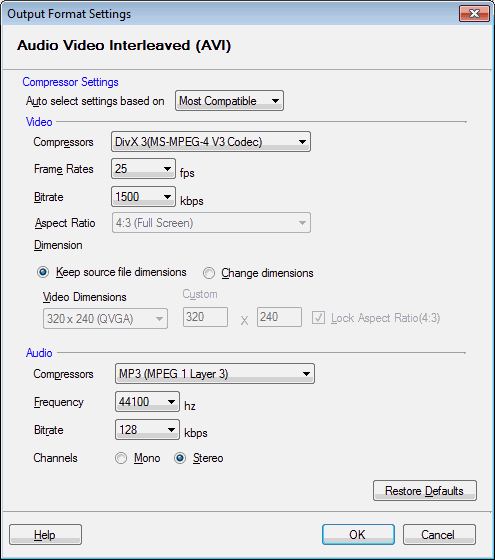
Digital Media Converter Pro can decide the best AVI properties for you based on the Video Compressors available on your computer.  The setting defaults to "Best Quality".

There are three preset choices for AVI files:

  • Best Quality
  • High Compression
  • Most Compatible

Read the articles: Reducing Video File Sizes and Understanding Compression in AVI

Video Dimension

With Digital Media Converter Pro you can either convert your video to AVI files with the same dimensions, or to new dimensions you select. To use the original dimensions, select Keep source file dimensions. To change the dimensions select Change dimensions. You can either select one of the standard formats, or specify custom dimension.

  • By default your converted file keeps the dimensions of the original file.
  • If you want to alter the aspect ratio of the video, select Change dimensions.
  • Increasing the size of a video can reduce the pictue quality. For example, if the file imported into your timeline originally had 320 x 240 dimensions, you should not save it to 640 x 480 pixels.  The resulting video might be distorted or "blocky" looking.   Reducing video dimensions can also result in unacceptable conversions, especially if there is a lot of detail in the picture.
  • The "Aspect Ratio" of a video image is the relationship between the width and the height.  Standard TV has an aspect ratio of 4:3, meaning that it is 3/4 as tall as it is wide.  Movies and HD TV have wider pictures, meaning a different aspect ratio.  If you choose to Change dimensions, you can unselect Lock Aspect Ratio.  If you know that you are converting widescreen movies, you should be sure that the dimensions you select are in the correct ratio before converting.

Compressor Settings

To apply a video compressor:

From the Video Compressors box select a compressor.  Unless you  have a reason to change it, one of the compressors chosen by the three preset definitions should be used.

Bitrate:

The Bitrate is the amount of information that is stored in the file to represent each second of video.  If you set a bitrate of 2000 Kbps, a 10 second video file will contain 20,000 bits of information about video.  (There will also be audio information.)  The higher the bitrate, the higher the quality of the video, but also the larger the size of the file.  Generally, smaller dimensions will allow you to use a lower bitrate and still have a good quality picture.

Frame Rate:

The Frame Rate of a media file is the number of frames that are displayed in one second. Files with a higher frame rate such as 25, 30 to 60 FPS (Frames Per Second) can show smoother motion than files with lower frame rates such as 10 or 15 FPS. However, video files with lower frame rate are much smaller than files with higher frame rates. 15 FPS is the norm that is usually followed for video created for Web use. You can configure the frame rate in two ways:

   1. Choose to keep the source file frame rate by selecting Keep source file frame rate option or,
   2. Change the frame rate of the converted file by selecting the Change frame rate option and move the slider to get the desired frame rate.

To apply an Audio Compressor:

From the Audio Compressor box select a compressor.  MP3 (MPEG 1 Layer 3) is very widely supported.  PCM audio is the most compatible, but also produces larger files.

Frequency

Audio Frequency is the number of times per second that the audio signal can be adjusted. 

Higher frequency values give better sound quality but also increase the size of the audio. Generally, use higher quality settings for music and lower for speech. Select from the Frequency dropdown. By default, the audio will be encoded at 44.1 KHz (which is audio CD quality).

Bitrate

As with video, the Bitrate is the amount of information that is stored in the file to represent each second of audio.  High bitrates mean higher quality, and larger files.  If a low sampling frequency is used, there is less information to save and using a lower bitrate does not result in lower audio quality.

Channels

Select Mono to include only one sound channel with your AVI file, and Stereo to include channels for both left and right speakers.  Using Stereo produces slightly larger files.

Copyright © DeskShare Incorporated. All rights reserved.